|
Strong and Functional
The lumber used in Free Spirit Farm raised garden beds is custom sawed to a thickness of 1 1/4 inches for greater strength and longer life. Mortise-and-tenon joints cannot pull apart, unlike beds that are nailed or screwed together.
No Chemical Wood Preservatives
Unlike pressure treated lumber or railroad ties, the native Nova Scotia hemlock used in our raised garden beds is untreated. There are no harmful chemicals that could leach into your soil and plants. All of the native hemlock lumber used for our boxes is sustainably grown without pesticides in northern Nova Scotia.
Very Easy Assembly
It takes less than five minutes to assemble Free Spirit Farm's raised beds. Simply slip the tenon through the mortise opening and secure with the wooden pegs we provide.
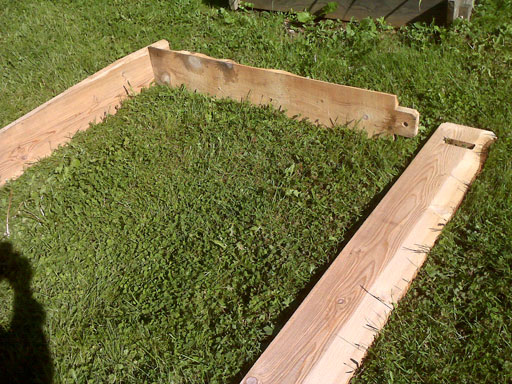
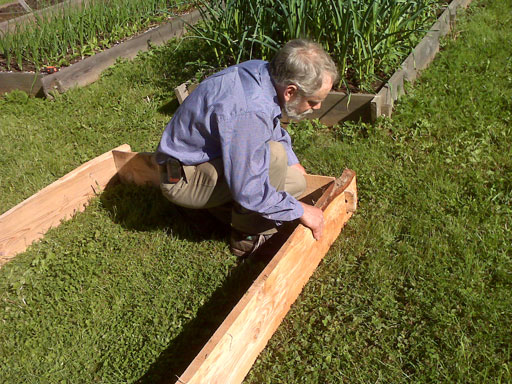
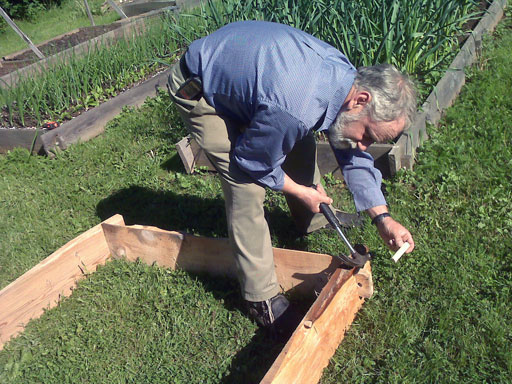
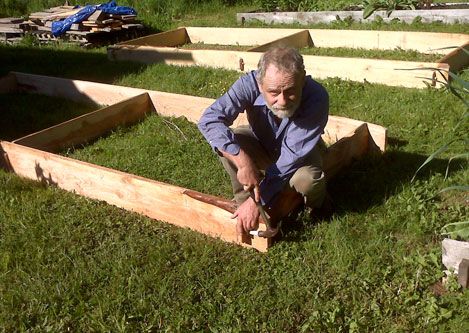
In this sequence, we first position the boards on the ground. Then fit all boards together by slipping the tenon pieces into the mortise pieces. Start the pegs, then tap the pegs into place with a mallet or hammer.
|
|
|
|
|
Raised beds can be placed directly onto lawn, sod, soil, or even a weedy patch. To keep weeds from growing up through the bed, place a thick layer of newspapers on the ground after assembling the bed and before filling it. We lift the boards slightly and slip the edges of the newspaper under the boards to ensure complete coverage. We also generously overlap the pieces of newspaper. Once the bed is filled, the newspaper and the vegetation underneath will slowly compost. This method works for us even for stubborn perennial weeds such as dandelion and goldenrod.
Fill Your Raised Beds
Once your raised beds are assembled and you have placed a barrier to smother existing vegetation, it is time to fill them with a soil mixture to suit your plants. Your choice will be determined by what you are growing and what is available to you. Here in northern Nova Scotia, for vegetables, we use a mixture that includes about 1/3 rich black soil (from an old barnyard), 1/3 compost or well-composted manure (usually a combination of the two), and 1/3 peat moss or coir. We combine this mixture in a wheelbarrow before dumping into the beds to ensure the components are evenly distributed. Then we add a couple shovels of sand sprinkled over the top of each bed, and some lime. The sand improves drainage because our black soil has clay in it. If you already have sandy soil, skip the sand. The lime is used to counteract the acidity of the peat moss, the manure and our acid rain. An easy guideline is to add lime at a little less than the rate you add it to your lawn. The first year we also add some blood meal, bone meal, and kelp meal to boost nitrogen, phosphorus, and potassium which are all vital for bountiful vegetable production. In future years, when this organic soil mix has had a chance to blend and establish good microbial activity, the additional amendments may not be necessary, and you can simply top up the bed with compost. Do not fill your raised beds with plain top soil. In that case there would be no advantage to making raised beds, you would still be planting into poor soil and your results would be disappointing.
Easily Add Accessories to Improve Your Yield
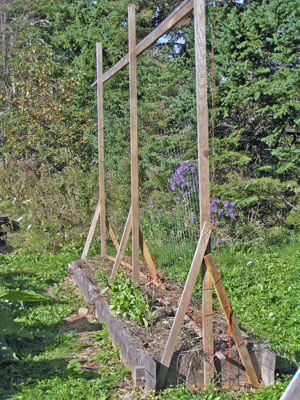
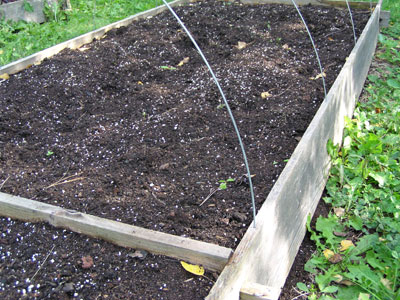
Free Spirit Farm raised bed kits are constructed of sturdy lumber, and it is easy to add gardening accessories. Supports for trellises can be screwed directly to the raised beds and removed at the end of the season for storage and moving to another bed in the spring to allow crop rotation. Wire hoops can be directly inserted into small holes drilled into the top edge of the boards. Use the hoops to support row covers for insect barriers or to support a mini greenhouse for season extension.
|
|
|
|
|
Trellis support in center of
two foot bed |
Trellis or stake support at rear of
four foot bed |
Wire hoops inserted into boards | |